
NuFACE Mini vs Trinity vs Fix: Which Microcurrent Device Should You Buy?
Choosing between the NuFACE Mini, Trinity, and Fix can feel overwhelming — they’re all from the same trusted brand, they all use microcurrent technology, and they all promise lifted, toned, more youthful-looking skin.
So which one actually deserves a spot in your skincare routine (and your budget)?
After diving deep into the specs, user reviews, clinical data, and real-world results, I’m breaking down exactly how these three devices compare — feature by feature, result by result — so you can make a confident decision without second-guessing yourself.
What Is Microcurrent Technology (And Why Does It Work)?
Before comparing the devices, let’s quickly cover what microcurrent actually does. Microcurrent therapy delivers low-level electrical currents (usually between 10–600 microamperes) that mimic your body’s natural bioelectrical signals. These gentle currents stimulate the facial muscles, encouraging them to contract and tone — kind of like a mini workout for your face.
The key benefits include:
- Muscle toning and lifting — facial muscles get firmer with consistent use
- Improved circulation — more blood flow means better nutrient delivery to skin cells
- Enhanced product absorption — microcurrent helps active ingredients penetrate deeper
- Collagen and elastin stimulation — long-term use supports your skin’s structural proteins
- Reduced fine lines and wrinkles — tighter muscles and better collagen = smoother skin
Clinical studies have shown that microcurrent can increase ATP (adenosine triphosphate) production by up to 500%, which is the energy currency your cells need to repair and regenerate. This is why dermatologists and estheticians have used microcurrent in professional treatments for decades — NuFACE just made it accessible at home.
Now, let’s break down each device.
NuFACE Mini: The Compact Starter Device
The NuFACE Mini is the brand’s entry-level device and the most affordable option in the lineup. It’s designed for people who are new to microcurrent or want a travel-friendly option they can use quickly.
Key Specs
- Price: ~$209 (often on sale for ~$170–$189)
- Microcurrent intensity: Single intensity level (335 microamperes)
- Treatment time: 5 minutes per session
- Attachment heads: One fixed treatment head (small sphere design)
- Power: Rechargeable battery
- Best for: Beginners, travel, quick daily treatments
Pros
- Most affordable NuFACE option — great entry point under $210
- Ultra-portable — fits easily in a purse or travel bag
- Simple to use — one button, one intensity, no learning curve
- Quick treatments — just 5 minutes a day
- Still delivers real results — users report visible lifting within 60 days
- Comes with a trial-size Activating Gel Primer
Cons
- No adjustable intensity — you’re locked into one level
- Smaller treatment head — takes more passes to cover the full face
- No interchangeable attachments — can’t add specialized heads
- Results may be more subtle compared to Trinity
- No smart app connectivity
Who Should Buy the Mini?
The Mini is perfect if you’re microcurrent-curious but not ready to invest $300+. It’s also ideal if you travel frequently and want something compact. If you’re in your 20s or early 30s and mainly want preventive anti-aging benefits, the Mini’s single intensity level is likely enough.
NuFACE Trinity: The Professional-Grade Powerhouse
The Trinity is NuFACE’s flagship device and the most popular option among serious skincare enthusiasts. It offers more power, more customization, and interchangeable attachments — making it the closest thing to a professional microcurrent treatment at home.
Key Specs
- Price: ~$339 (often on sale for ~$279–$309)
- Microcurrent intensity: Five adjustable intensity levels (up to 335 microamperes)
- Treatment time: 5–20 minutes per session (depending on routine)
- Attachment heads: Interchangeable — facial trainer (default), wrinkle reducer (LED + microcurrent), and ELE attachment (for eyes and lips)
- Power: Rechargeable battery
- Best for: Serious anti-aging, customizable treatments, long-term commitment
Pros
- Five intensity levels — start low and build up as your skin adapts
- Interchangeable attachments — target wrinkles, eye area, and lips specifically
- Larger treatment head — covers more surface area per glide
- Professional-grade results at home — closest to an in-office treatment
- LED wrinkle reducer attachment available — combines microcurrent with red light therapy
- Smart app connectivity — guided routines and tracking
- More clinical backing at this intensity range
Cons
- Higher price point — $339 base, attachments sold separately ($100–$149 each)
- Bulkier than the Mini — less travel-friendly
- Learning curve — more settings and options to figure out
- Full routine takes 15–20 minutes — bigger time commitment
- Attachments add up cost-wise — a full set can push total investment past $500
Who Should Buy the Trinity?
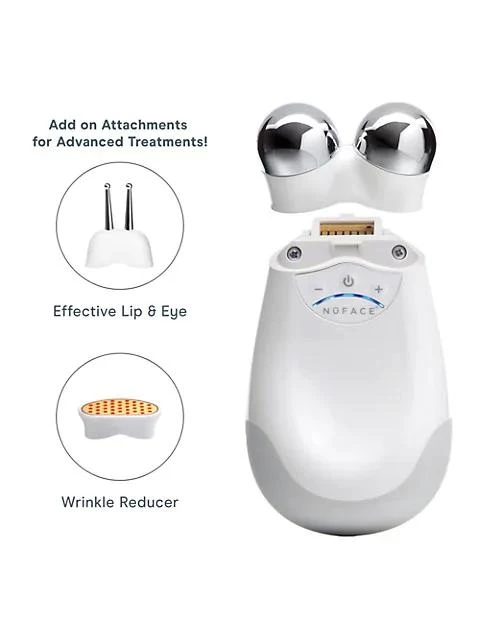
If you’re serious about at-home anti-aging and want the most versatile microcurrent device available, the Trinity is your pick. It’s ideal for people in their mid-30s and beyond who want to address specific concerns like jawline sagging, forehead lines, or under-eye puffiness. The interchangeable attachment system means it can grow with your needs.
If you’ve already been using an at-home skincare device routine and want to level up, the Trinity is the natural next step.
NuFACE Fix: The Targeted Line Smoother
The NuFACE Fix is fundamentally different from the Mini and Trinity. While those devices focus on lifting and toning entire facial areas, the Fix is a precision tool designed to smooth fine lines and wrinkles in specific spots.
Key Specs
- Price: ~$159
- Technology: Microcurrent + massage
- Treatment time: 3 minutes per area
- Design: Pen-shaped with a fine-tip applicator
- Power: AAA battery
- Best for: Targeted wrinkle treatment, on-the-go touch-ups, complement to other devices
Pros
- Most affordable NuFACE device — under $160
- Precision targeting — treats specific lines (crow’s feet, smile lines, forehead lines, lip lines)
- Ultra-portable pen design — fits in any bag or pocket
- No conductive gel needed — uses its own serum-infused tips
- Great as a complement to the Mini or Trinity
- Instant smoothing effect on fine lines
Cons
- Not a full-face treatment — won’t lift or tone like the Mini/Trinity
- Replacement tips required — ongoing cost ($15–$20 per set)
- Uses AAA batteries — not rechargeable
- Results are more subtle and temporary without consistent use
- Lower microcurrent output than the other two devices
- Not a standalone anti-aging solution
Who Should Buy the Fix?
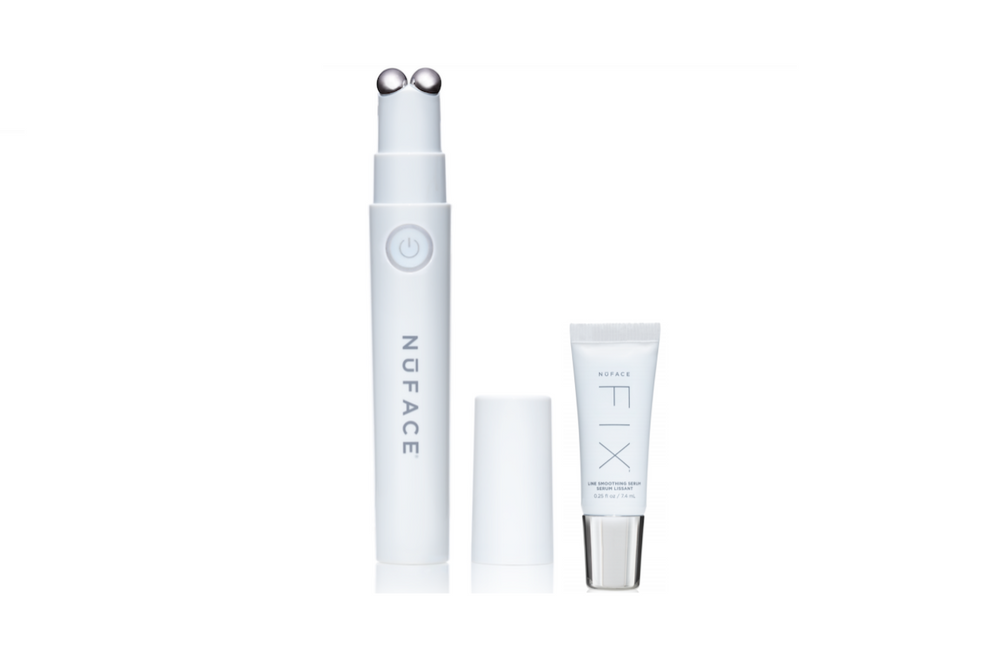
The Fix is best as a complement to another NuFACE device, not a replacement. If you already own the Mini or Trinity and want to add targeted wrinkle treatment, the Fix fills that gap perfectly. It’s also a good standalone option if your only concern is fine lines in specific areas (like crow’s feet or lip lines) and you’re not looking for full-face lifting.
NuFACE Mini vs Trinity vs Fix: Head-to-Head Comparison
Here’s how all three stack up across the features that matter most:
Price: Fix ($159) → Mini ($209) → Trinity ($339)
Primary purpose: Fix targets specific wrinkles. Mini provides full-face toning. Trinity delivers full-face toning plus customizable treatments.
Intensity levels: Fix has one. Mini has one. Trinity has five adjustable levels.
Interchangeable attachments: Only the Trinity supports them.
Treatment time: Fix takes 3 minutes per area. Mini takes 5 minutes. Trinity takes 5–20 minutes depending on your routine.
Portability: Fix (pen-sized) > Mini (compact) > Trinity (standard device).
Gel required: Yes for Mini and Trinity. No for Fix (uses serum tips).
Best results for lifting/toning: Trinity > Mini > Fix.
Best results for fine lines: Fix > Trinity (with ELE) > Mini.
Which NuFACE Should You Buy? My Recommendations
After analyzing all three devices, here’s my honest recommendation based on different scenarios:
Buy the NuFACE Mini If…
- You’re new to microcurrent and want to try it without a big investment
- You travel a lot and need something compact
- You’re in your 20s–early 30s focused on prevention
- You want a simple, no-fuss daily routine
- Your budget is under $250
Buy the NuFACE Trinity If…
- You’re serious about anti-aging and willing to invest long-term
- You want professional-grade results at home
- You’re in your mid-30s or older with visible aging concerns
- You want the option to add specialized attachments over time
- You’ve tried the Mini and want to upgrade
- You want adjustable intensity to customize your treatments
Buy the NuFACE Fix If…
- You already own the Mini or Trinity and want targeted wrinkle treatment
- Your primary concern is fine lines in specific areas
- You want something for quick touch-ups throughout the day
- You don’t need full-face lifting or toning
- Budget is your main concern (under $160)
Best Value Pick
For most people, the NuFACE Trinity offers the best long-term value. Yes, it’s more expensive upfront, but the adjustable intensity levels and interchangeable attachment system mean you won’t outgrow it. You’re investing in a platform, not just a device.
If budget is tight, start with the Mini — you can always upgrade later.
How to Get the Best Results from Any NuFACE Device
Regardless of which device you choose, these tips will help you maximize your results:
1. Consistency Is Everything
NuFACE recommends using your device 5 days a week for the first 60 days, then 2–3 times a week for maintenance. Most people who report “it didn’t work” quit before the 60-day mark. Microcurrent is cumulative — you need to build on the results.
2. Always Use a Conductive Gel
For the Mini and Trinity, a conductive gel is non-negotiable. It allows the microcurrent to properly travel through your skin. NuFACE’s own Gel Primer works well, but there are also great alternatives on Amazon if you want to explore options. Using the device on dry skin can cause discomfort and reduce effectiveness.
3. Follow the Right Technique
Always glide upward and outward. Start from the jawline and work your way up to the forehead. Hold the device at each “lift point” for a few seconds. Don’t rush — slow, deliberate movements get better results than speed-gliding.
4. Pair with the Right Skincare
After your microcurrent session, your skin is primed for absorption. This is the perfect time to apply serums with hyaluronic acid, peptides, or vitamin C. As we covered in our guide on the science behind light therapy, combining technologies amplifies results.
5. Combine with LED Therapy
Microcurrent and LED light therapy are a power duo. Use your NuFACE first (it works on muscles), then follow with an LED mask like the CurrentBody Skin (which works on skin cells). Together, they address both the muscular and cellular layers of aging.
What About the NuFACE Trinity+ (2024 Upgrade)?
NuFACE released the Trinity+ as an updated version of the original Trinity. Key upgrades include improved microcurrent delivery with their Innovative Pulse Technology (IPT), which NuFACE claims is up to 25% more effective than the original Trinity. The design is slightly more ergonomic, and it pairs with a redesigned app for guided treatments.
The Trinity+ is priced at ~$395, making it the most expensive handheld option. If you’re buying new, the Trinity+ is worth the extra $50–$60 over the classic Trinity. But if you find the original Trinity on sale, it’s still an excellent device that delivers real results.
Common Questions About NuFACE Devices
Does microcurrent hurt?
No. Most people describe the sensation as a gentle tingling. Some areas (like the forehead) are slightly more sensitive, but it shouldn’t be painful. If it hurts, you likely need more conductive gel.
How soon will I see results?
Many users notice an immediate “lifted” look after their first session, though this is temporary. With consistent use (5 days/week), lasting results typically appear around the 60-day mark. Full results develop over 3–6 months.
Can I use NuFACE with Botox or fillers?
Wait at least 2–4 weeks after Botox or filler injections before using any microcurrent device. Consult your dermatologist for personalized guidance.
Is NuFACE safe for all skin types?
Yes, microcurrent is safe for all skin types and tones. However, it’s not recommended for people with epilepsy, heart conditions, pacemakers, or during pregnancy. When in doubt, consult your healthcare provider.
Can I use the NuFACE on my neck and body?
You can use the Mini and Trinity on your neck and décolletage. Some people even use them on hands. The Fix is really only designed for facial fine lines.
Final Verdict: NuFACE Mini vs Trinity vs Fix
All three NuFACE devices deliver on their promises — but they serve different needs.
The Trinity is the gold standard for at-home microcurrent. If you can afford it and you’re willing to commit to a consistent routine, it will deliver the most dramatic, long-lasting results. The adjustable intensity and interchangeable attachments make it the only device you’ll need.
The Mini is the smart entry point. It won’t give you the customization of the Trinity, but it absolutely works — and at $130 less, it’s a great way to test whether microcurrent is right for you before going all-in.
The Fix is the specialist. Don’t buy it as your only device unless fine lines are your sole concern. But as a complement to the Mini or Trinity? It’s a fantastic addition that fills a gap the other two can’t reach.
No matter which you choose, remember: consistency beats intensity. A Mini used daily will outperform a Trinity gathering dust in a drawer. Choose the device that fits your life, your budget, and your commitment level — then stick with it.
Your future skin will thank you. ✨